 Enlarge
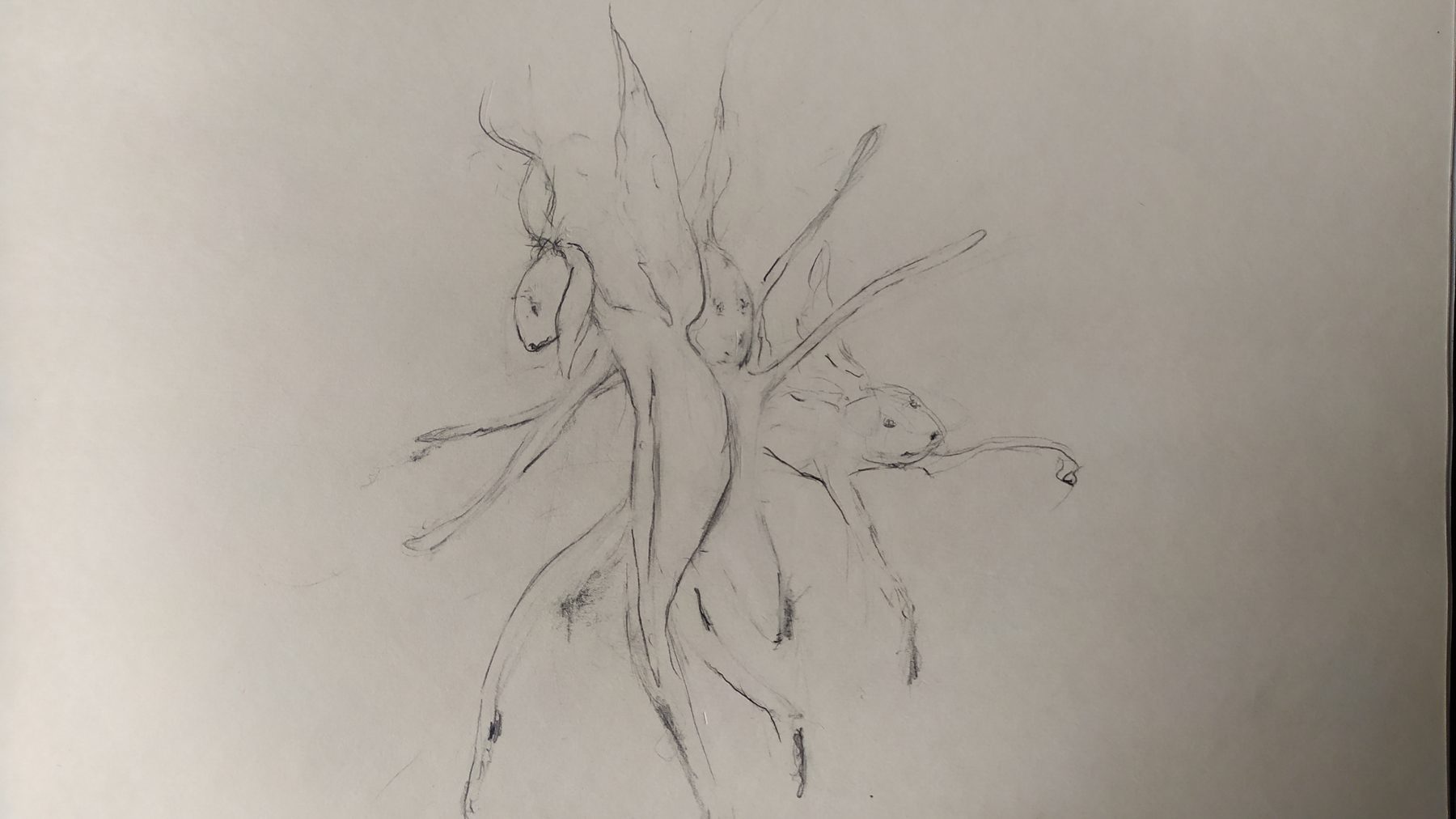
Centzon Totochin — 2011. Graphite.
However sublime the result, the path that led from grape to wine seemed clearly marked out, like the one from cereals to beer — the latter barely disturbed by a stopover at the bakery. But you had to be twisted to hope to draw a wine from those agaves which, for us, serve only to point the way to Italy. At around 5% alcohol, a fine bluish white, viscous and slightly sparkling, sweet and then sour, pulque is even more Mexican than tequila or mezcal, and is worth the journey all on its own, as that other limper would write.
But if it was the drink of Moctezuma, today it is hardly drunk any more except by charcoal burners and students in search of lost causes. Should we lament to see this wild beverage supplanted by sensible pasteurised beer?
Certainly not, for how could it have been otherwise? That it can only be sold in bulk around the areas of production, and that the raw material has a growth cycle of some ten years, were insurmountable limiting factors, quite apart from any consideration of quality; and if you add the very particular taste — pleasant, but apt to veer towards the frankly sour — there was no real need to give battle in order to lose it. So it is not unusual, in the pulquerías, to hear the eldest declaim his weariness of pulque (melt in Otomi) while sipping his small share of modernity, with its frank and emancipating drunkenness: a bad rum.
At most one might regret a few low blows used to discredit pulque, such as that rumour, still doing the rounds, of the munequita, the little doll. It is nothing less than a dirty sock (as fine as Zola!) stuffed with a human or canine turd, as the case may be, which is supposedly thrown into the barrel of aqua miel to speed up its fermentation! Slander!
Or a clumsy interpretation of the slice of nopal, an edible cactus of vaguely anthropomorphic shape that is dipped into it (more, it seems, to help it keep) and of the smell of fermentation, which can be disconcerting, like any smell of fermentation.
Pulque! A ghost that hides and lets itself be forgotten even in the towns whose prosperity it once ensured; an effacement in the form of a sacrifice for this sacrificial drink, the fermented sap of a plant that yields its single harvest only after 7, 10, 15 or even 25 years, before dying in the course of a slow agony lasting several months.
Each plant descends from a line of clones that may go back to the dawn of time
If its consumption during the ritual immolation of young men and young women certainly owed much to its alcoholic character, the almost literal analogy between a young adolescent girl with her throat cut and the plant in its 15th year, which is beheaded to prevent it from flowering before its heart is worked over, made it the obvious drink to accompany these ceremonies — perhaps even their original instigator. (Let us add that the maguey is propagated vegetatively by layering, so that each plant descends from a line of clones that may, if you like, go back to the dawn of time, and that the possibility of an immortality through XXXXXX) And it is perhaps here that one can measure how far the generosity of the vine, with its annual harvest, may have been a source of abstraction ....Corpus christis in vino veritas dura lex sed lex, tabernacle !

Bridgehead of the fellowship of the “Pasteur shall not pass”, comet's tail of the “don't put me in a can or I'll explode”, a magnificent loser in the land of coloured liqueurs, starred wines and other cocktail spirits, pulque remains a drink with a strong emotional charge; to bring it out of hiding, to bring it into the light as A.T. did on line 32 of the Mexico City metro (yes, yes, into the light, for it is an overground line)… is assuredly to expose oneself to a half-riot of weeping men snatching the bottle from one another to suckle at it greedily (San Agustín del pulque, la Michoacana doesn't sell any — Mexico City — 2004). Given its anachronistic character, one may wonder what future is taking shape for pulque, between survival and prospects for development.
With all due respect to the deathly impulses of sociology students — sinister guardians of the temple who claim to know how to drink, and how to make others drink, as the peasants of the Mezquital have long since ceased to drink — the future seems to be assured, in large part, by the joyful and slightly vulgar Pulmex: establishments with an orchestra and proud signs, vast and bright, where people come, as a family or not, to knock back pulque and eat oysters. Essential, because the Pulmex are taking the place of the now austere pulquerías as the main outlet for producers, and are keeping consumption alive in the towns, in the liveliest of ways, alongside that of the countryside
Pulque baths in the colonial pools
And, to open a new path, let us imagine how pulque might be given value if a luxury pulque were developed, which an international clientele would come not only to taste but to take as a cure in former estancias. Its wealth of vitamins and bacteria would be the pretext for rejuvenation cures, pulque baths in the colonial pools, treatments of every kind and, to make it worth the while, gastronomic meals of marvellous Mexican cuisine — diet or not — washed down with pulque of course, drunk all day long from Bohemian crystal glasses, interspersed with hunting and cross-country golf among the agaves. A megalomaniac delirium, perhaps!
But what finer tribute than all those naked bodies, with opulent breasts both real and fake, bathing in melt, to the very gods of pulque, to Mayahuel, goddess of the maguey and of pulque, Mayahuel and her 400 breasts; 400 breasts beading with pulque, at which come to suckle Centzon Totochin, the 400 rabbits. 400 rabbits for the 400 degrees of drunkenness, a subtle increment from 1 to 400 for 400 states of inebriation... A cure to fill the gaps between “tipsy as a fox” and “drunk as a lord”! The adventure continues!